Showing posts with label ceramics. Show all posts
Showing posts with label ceramics. Show all posts
Thursday, June 23, 2011


Tuesday, June 7, 2011
Sunday, June 20, 2010
Why Ceramics?

Archaeologists spend a lot of our time discussing ceramics but it is not always clear to those listening why that may be such an important part of our research. On our site this year we have found a variety of ceramics some smaller than a penny and some as large as our fists but each of these sherds can provide information about the people who lived and worked on this landscape. There are a variety of reasons that ceramics are vital to archaeology including but not limited to their potential for social and household interpretations.
Each time you pick up a ceramic sherd you can potentially learn about the type of vessel (form), the purpose of that vessel, what kinds of decorations graced the body and how this vessel was made. These types of information can help archaeologists learn about the household and how it functions. One important piece of information that ceramics can provide is information on gender roles within a household. In Cherokee society women held much of the control over ceramics because they created the vessels. Theda Perdue (1998) in her book Cherokee Women: Gender and Culture Change, 1700-1835, describes the vessels made by women as pitchers, bowls, dishes, basins and platters. Most of the vessels we have examined in our lab time and in the field have been bowls of varying sizes.
Ceramic sherds can also provides us with information about how vessels are made, for example temper or coiled versus hand formed. We have learned quite a bit this summer about the different types of temper that are common in ceramics for our region. We have had the opportunity to examine shell tempering, grit tempering and sand tempering. Looking at all of these types of tempering has been interesting because it gives us a better idea of how these pots were made and where the materials may have been coming from.
Ceramics are also vital to archaeology because of their presence in the archaeological record. Ceramics simply preserve well in most contexts and are relatively fragile during use. This seemingly contradictory fact makes ceramics both easily destructible, getting deposited in the archaeological record frequently, and well preserved. This good preservation is great for archaeologists because it provides us with a wealth of information about households and social relations within a community or even a region.
Thursday, June 17, 2010
Day 13 and 14 - Getting to the Bottom of Things
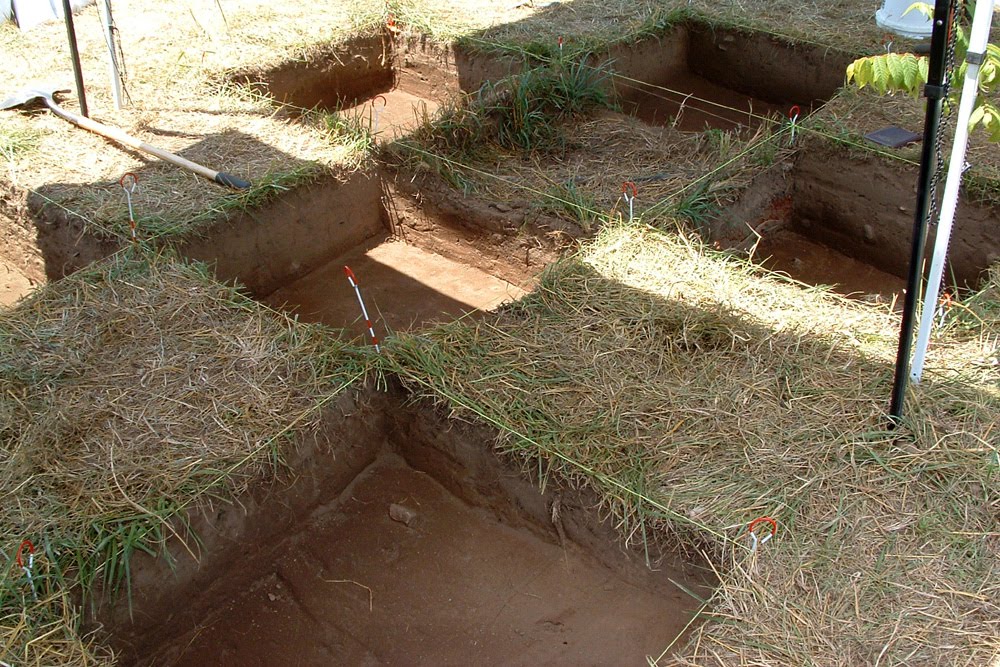
The last couple of days in the field have proven to be rather eventful - students have finally reached the bottom of the plow zone in their units, and have descended onto the cultural layer that is the focal point of this archaeological investigation. Although this layer is a sort of "living surface" with culturally sterile soil not far below, this is the layer where features such as post molds and structural foundations are going to turn up and is thus vitally important. Students will from this point onward trowel very carefully and deliberately through their levels.
Most units have shown a mottled soil still consisting of some plow zone soil. Some even have distinct trenches cut into the cultural layer filled with plow zone soil - a clear sign of a plow scar that long ago dug into that layer. One unit, however (20 South 22 East), does appear to have a post mold. It is nothing like the numerous post molds found in last years 20 South 15 East (which we uncovered again over the past couple of days for reanalysis and point of comparison with other units), but shows promise that an extensive number of structures once existed at this site.
 The post mold in unit 20 South 22 East
Not surprisingly, artifact finds are proving to be more and more interesting. Some of the highlights include a couple of lithic cores, a few large pottery sherds with surface decoration, and one large piece of iron seen below.
 The mysterious piece of iron.
 The mysterious piece of iron.
Other than its material, we are unsure what sort of object it may have been. Based on its flat shape, we have speculated that it may have been attached to a wooden surface. The likelyhood of proper identification remains to be seen.
Most decorated pot sherds found over the last few days have either been check stamped or cord marked, both of which are surface treatment styles common to the Woodland Period of East Tennessee, but not necessarily unheard of in Mississippian and/or historical contexts.
 A check stamped sherd, in situ.
Most decorated pot sherds found over the last few days have either been check stamped or cord marked, both of which are surface treatment styles common to the Woodland Period of East Tennessee, but not necessarily unheard of in Mississippian and/or historical contexts.
 A check stamped sherd, in situ.
One sherd uncovered during the last couple of days, however, appears to be a rectilinear complicated stamped. Complicated stamped surface treatments are typical of Mississippian cultures found throughout what is today Georgia, South Carolina, and parts of northern Florida, North Carolina, Alabama, and Tennessee. This stylistic attribute is definitive of Mississippian and historic cultural sequences in western North Carolina and upper East Tennessee.


Though badly damaged in the plowzone, this sherd above shows the telltale stamped lines and corners typical of a rectilinear complicated stamp motif.
 One of our field school students, Katie, proudly showing off the sherd, which was found in her unit.
The next few days of field excavation will only reveal more exciting artifacts and features, as students carefully excavate through the undisturbed cultural layer in their respective units. Tomorrow, however, the crew will be taking a field trip to the Berry site in North Carolina, where excavations are currently underway. Come Monday, students will be back to work for their final week of field work. Stay tuned to this blog for more updates!
Monday, June 14, 2010
Day 11 - Welcome to the Lab
We're shifting into high gear with lab analysis, as the students work to analyze some of the materials (currently ceramics) collected at the site. So I decided (that's me in the video below, the lab director) to give a brief intro to our laboratory. I hope to show some of the students' analysis work, and perhaps some of their conclusions, at a future date.
Friday, June 11, 2010
Day 10 - Crazy from the Heat
After two days of deluge, today's foray into the field was met with extreme heat and humidity. Despite this, and the usual exhaustion and exasperation such excavation situations bring, the work day proved to be very interesting. Although hot and humid, the ground and equipment were dry, and therefore we were able to devote a normal full day to field work. The day started with taking a Munsell reading of yesterday's levels, and then students began troweling and shovel-skimming their way down to the bottom of their level 3's. As the morning progressed, some of the students got up-close and personal with some of the local wildlife:

We have encountered about three spiders of roughly this size in the field so far this season. Aside from obvious examples such as tarantulas, these are some of the largest spiders many of us have ever seen. Let us hope "human" isn't on this critter's menu.
Despite the uncomfortable weather, work went on as usual. Here are a few notable action shots of the day:
 Working hard sifting dirt.
 This one goes to Eleven
(video clip in case you aren't familiar with the phrase)

We have encountered about three spiders of roughly this size in the field so far this season. Aside from obvious examples such as tarantulas, these are some of the largest spiders many of us have ever seen. Let us hope "human" isn't on this critter's menu.
Despite the uncomfortable weather, work went on as usual. Here are a few notable action shots of the day:
 Working hard sifting dirt.
 This one goes to Eleven
 (video clip in case you aren't familiar with the phrase)
Today's excavations produced a particularly interesting find: a very nicely-preserved check-stamped ceramic sherd.

Check-stamped ceramics are common during the Woodland period of East Tennessee, but are also not unusual in Mississippian or historic contexts as well. Many of the students agreed that this particular specimen was the nicest preserved one they had seen - possibly even nicer than other check-stamped sherds in our type collection!
 One of the students showing off her spectacular find of the day: the check-stamped sherd.

Check-stamped ceramics are common during the Woodland period of East Tennessee, but are also not unusual in Mississippian or historic contexts as well. Many of the students agreed that this particular specimen was the nicest preserved one they had seen - possibly even nicer than other check-stamped sherds in our type collection!
 One of the students showing off her spectacular find of the day: the check-stamped sherd.
Many other students were proud of their finds this week as well. Here are a few more pictures of students showing off their finds from earlier in the week:
 A ceramic sherd.
 Another ceramic sherd.
 A ceramic sherd.
 Another ceramic sherd.
As the day progressed, the weather got increasingly oppressive. Thankfully, the owner of the land where the Yellow House site is located came to our rescue and brought us some tents to work under for the remainder of the afternoon. They were a pain to set up and take down, but they did provide a reprieve from the glaring sun for awhile.
 Working in luxury.
As the afternoon progressed and the students continued digging, measuring, sifting, and bagging; Dr. Jeb Card and Burton Smith began opening up last year's unit 20S 15E, which was the unit with the post holes. We hope to have the living floor of this unit reopened for analysis and visual reference by early next week.
At the end of the day, most students had finished or had come close to finishing their level 3's. Between downpours, mud, and oven-hot conditions, the students persevered without complaint this week. With the arrival of the weekend, they get a much-needed break, and will begin again fresh on Monday.
 Working in luxury.
As the afternoon progressed and the students continued digging, measuring, sifting, and bagging; Dr. Jeb Card and Burton Smith began opening up last year's unit 20S 15E, which was the unit with the post holes. We hope to have the living floor of this unit reopened for analysis and visual reference by early next week.
At the end of the day, most students had finished or had come close to finishing their level 3's. Between downpours, mud, and oven-hot conditions, the students persevered without complaint this week. With the arrival of the weekend, they get a much-needed break, and will begin again fresh on Monday.
Tuesday, June 8, 2010
Day 6 and 7 - Groundbreaking! (Excavation Begins)

By B. Smith
After a week of surveying and learning about some of the background history and prehistory of northeastern Tennessee, the students were finally ready to start breaking ground on the Yellow Cabin Site. Excavations this year will focus primarily on the area around last year's Operation 1, unit number 20 South 21 East, which produced some curious features filled with charcoal. On Monday the students started out helping to measure out 2X2 meter grids, which were subsequently subdivided into 1X1 meter grids to be converted into test units.
 Measuring out a grid, and double-checking appropriate point distances with the hypotenuse.
 Altogether, six units were parceled out for excavation - one per student, and an additional unit to be worked on by both lab director Dr. Jeb Card, and field director Burton Smith. After the students received their designated 1X1 test units, they began the arduous task of clearing off excess brush and tall grass off of the surface.
 Clearing the surface.
Once the units were all reasonably cleared, the students assisted in shooting in elevation points in their units with the total station.
 Holding the stadia rod and prism in place.
By Tuesday morning, students were ready to establish their datums and start digging down 5 centimeters to the bottom of their first level. Since the surface soil was plow zone and choked with thick roots, this task was accomplished through the use of shovels for skimming, with some troweling to smooth out the floor. The students struggled through the roots, but all managed to finish their first level by the end of the day. They even managed to bag, pack up, and haul away all of the dry-screened soil from their individual units, to be water-screened at a later date.
 All students were able to finish their levels before the end of the day.
The plow zone at the Yellow House Site represents a completely disturbed context that can extend below the surface to about 20 or 25 centimeters. In spite of this decontextualized soil horizon, artifacts found here can still give clues to the nature of cultural activity preserved below the plow zone line. Students collectively uncovered several artifacts - sand or grit-tempered ceramic sherds, lithic flakes made from local chert, fire-cracked rocks, as well as the occasional artifact of more recent periods (plastic). Not bad for the first day!

 Two examples of some of our first finds of the season - a couple of small ceramic sherds.
The students definitely deserve praise - they've worked very hard and diligently, and have been very productive with the time allotted for excavating. With any luck, we may yet be able to finish these first sets of units and open up new units around last year's Operation 5, unit number 20 South 15 East, which produced a series of small post holes.
Subscribe to:
Posts (Atom)