Showing posts with label cherokee. Show all posts
Showing posts with label cherokee. Show all posts
Monday, July 5, 2010


Monday, June 7, 2010
Day 5 - Cherokee, North Carolina

By Project Director, Dr. Kathryn Sampeck
We ended our week of learning about the landscape by traveling to Cherokee, North Carolina to meet with the Eastern Band of the Cherokee Indians (ECBI) Tribal Historic Preservation officers and to explore different museums in Cherokee. Our project has strong ties with the ECBI and benefits from active collaboration and participation of members of the ECBI.
The route from Greeneville, Tennessee to Cherokee features has stunning scenery in the Appalachian Mountains, passing through the Cherokee National Forest and the Pisgah National Forest. Even today’s highways have to negotiate steep twists and bends before descending into the Asheville Basin. Nevertheless, the early historic material culture from Washington and Greene Counties show strong similarities to these parts of today’s North Carolina, so these mountains were not an impassable barrier in the past.
We started our visit with a tour of the sacred site of Kituwah. ECBI archaeologist Russ Townsend explained that all Cherokee regard Kituwah as the mother place, where the first Cherokee council fire burned and that Kituwah has always been important in Cherokee life. ECBI historian Tyler Howe and archaeologist Yolanda Saunooke showed field school students different parts of the site, including the medicine place near the Tuckasegee River.
We next visited the living history museum of the Oconaluftee village. There we saw craftworkers producing traditional Cherokee material culture, including projectile points, wood carvings, baskets, and belts. Guides explained Cherokee political and social organization in detail as part of their tour. In the mid-afternoon, we attended a demonstration of several social dances in the village dance grounds. Ocunaluftee has model homes typical of different time periods, allowing us to see changes in architecture from the 1540s to the nineteenth century. Being able to step inside a sweat lodge or an 1830s house gives us a better sense of archaeological traces of the past.

Potter's tools from Oconauftee include a paddle for decorative marking and shells for incising and scraping.
After the village, we ended our visiting day in the Museum of the Cherokee Indian. Exhibits cover each major period of Cherokee history, from the earliest Paleoindians and their stone tools to Cherokee soldiers in World War II. The museum is notable for its detailed presentation of the historic period, especially the eighteenth and nineteenth centuries. This week the students have been studying Mooney’s Myths of the Cherokee, and a number of narratives collected in that work were vividly depicted and recounted at the museum. Regarding material culture, whole ceramic vessels. much like the small fragments we are studying in the project lab, were on display, as well as more recent pieces. The whole day gave us many perspectives on the place, history, and peoples we are studying.
 Early spear points
Printed in the Cherokee script
We returned to Tennessee on a different route, this time through the Great Smoky Mountains National Park. Rain soon drenched the roads and forests, but after a short while the sky brightened and a shimmering rainbow shone before us, the perfect end to our day.

Wednesday, June 2, 2010
Day 3 -- Survey of Washington County
By Project Director, Dr. Kathryn Sampeck

Moving out of our home base and environs, today we broadened horizons and explored the numerous historical sites of Washington County, Tennessee. In comparison with the parts of Greene County we visited yesterday, we could appreciate some of the unique features of early historic settlement in Washington County. One of these is the abundance of rich soils near the Nolichucky River. Cherokee towns in Washington County often were situated in pairs, one on each side of the river, a pattern not seen in Greene County, where fertile river plains on one side often face steep bluffs on the other shore. These paired villages in Washington County may have had a distinctly different sociopolitical dynamic because they could see each across the river.
 The Nolichucky River
We have to remember that the more recent sociopolitical division of Washington and Greene Counties should not overshadow our interpretations of the past. We also noted that today's county divisions perhaps encourage us to think that areas were divided, but we could see that some areas between Washington and Greene County were easily accessible by the old road system. We noticed that in general, Washington County had more early historic Cherokee towns (after contact with Europeans) that were fairly regularly spaced along the Nolichucky River, and a few other early historic Cherokee towns near smaller creeks such as Little Limestone Creek.

One of the most distinct settlements in the region is found in Washington County, on National Forest Service land at the edge of the Cherokee National Forest. One of the largest Cherokee towns in eastern Tennessee was located near Jackson Island. Archaeological excavations conducted in the 1970s revealed Spanish goods and extensive settlement. Also, the site was probably occupied earlier than many of the Cherokee towns in the region, judging from the presence of artifacts not in use after European contact.
This area was also one of the first homes of John Sevier, the first governor of Tennessee. Overgrown with trumpet vines, tickweed, and river cane, the chimney of his house look for all the world like an ancient jungle ruin, less preserved than persisting. While visiting the grounds, we found on the road surface, and left according to federal regulations, a fragment of a 19th century stoneware vessel, possibly a product of the nearby Decker pottery. The Sevier house is located on a hill with a dramatic view of the river plain.
 Federal warning about damaging the site or removing materials
 20th century stairs leading to the 18th century ruins of the John Sevier House

 Examining the chimney
 19th century stoneware found, and replaced, on the surface of the road.
This may have come from a Decker vessel.
After visiting nearly a dozen archaeological sites in Washington County, we stopped and enjoyed (literally) the fruits of the land, on sale at a local farmers' market.


After these two days of focus site survey, we can appreciate the special place in Cherokee history of the site we will begin mapping and excavating over the coming weeks, the Yellow House Site.

Moving out of our home base and environs, today we broadened horizons and explored the numerous historical sites of Washington County, Tennessee. In comparison with the parts of Greene County we visited yesterday, we could appreciate some of the unique features of early historic settlement in Washington County. One of these is the abundance of rich soils near the Nolichucky River. Cherokee towns in Washington County often were situated in pairs, one on each side of the river, a pattern not seen in Greene County, where fertile river plains on one side often face steep bluffs on the other shore. These paired villages in Washington County may have had a distinctly different sociopolitical dynamic because they could see each across the river.
 The Nolichucky River
We have to remember that the more recent sociopolitical division of Washington and Greene Counties should not overshadow our interpretations of the past. We also noted that today's county divisions perhaps encourage us to think that areas were divided, but we could see that some areas between Washington and Greene County were easily accessible by the old road system. We noticed that in general, Washington County had more early historic Cherokee towns (after contact with Europeans) that were fairly regularly spaced along the Nolichucky River, and a few other early historic Cherokee towns near smaller creeks such as Little Limestone Creek.

One of the most distinct settlements in the region is found in Washington County, on National Forest Service land at the edge of the Cherokee National Forest. One of the largest Cherokee towns in eastern Tennessee was located near Jackson Island. Archaeological excavations conducted in the 1970s revealed Spanish goods and extensive settlement. Also, the site was probably occupied earlier than many of the Cherokee towns in the region, judging from the presence of artifacts not in use after European contact.
This area was also one of the first homes of John Sevier, the first governor of Tennessee. Overgrown with trumpet vines, tickweed, and river cane, the chimney of his house look for all the world like an ancient jungle ruin, less preserved than persisting. While visiting the grounds, we found on the road surface, and left according to federal regulations, a fragment of a 19th century stoneware vessel, possibly a product of the nearby Decker pottery. The Sevier house is located on a hill with a dramatic view of the river plain.
 Federal warning about damaging the site or removing materials
 20th century stairs leading to the 18th century ruins of the John Sevier House
 Examining the chimney
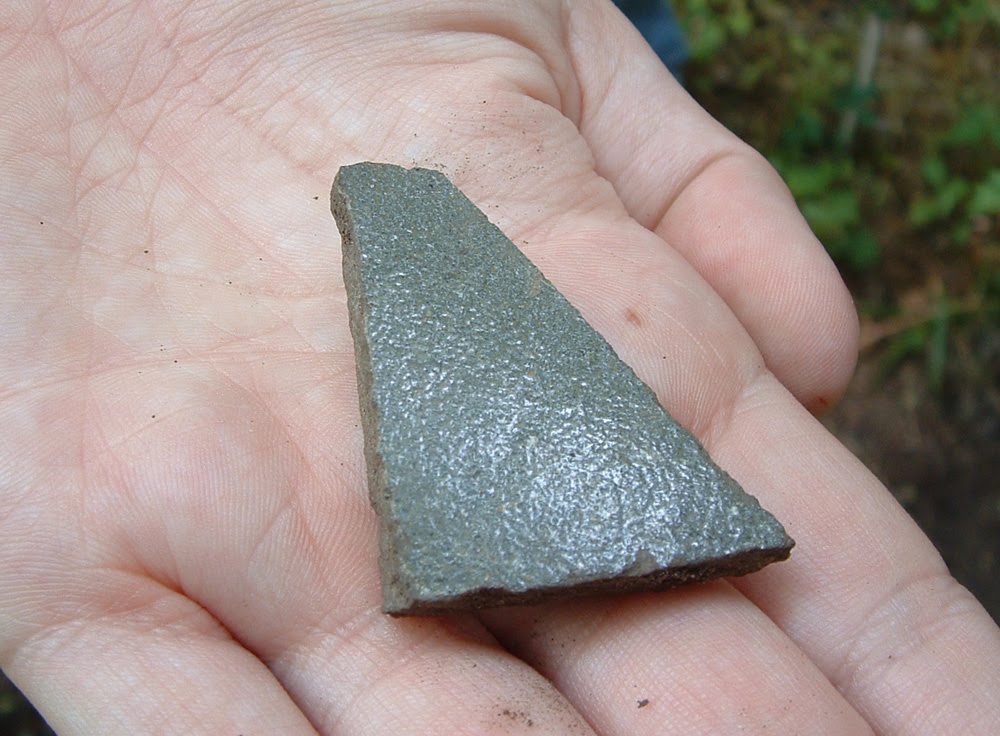 19th century stoneware found, and replaced, on the surface of the road.
This may have come from a Decker vessel.
After visiting nearly a dozen archaeological sites in Washington County, we stopped and enjoyed (literally) the fruits of the land, on sale at a local farmers' market.


After these two days of focus site survey, we can appreciate the special place in Cherokee history of the site we will begin mapping and excavating over the coming weeks, the Yellow House Site.
Tuesday, June 1, 2010
2010 Illinois State University Field School in Historical Archaeology - Cherokee Towns in the Time of Spanish Contact
This blog will be chronicling some of the activities of the 2010 Illinois State University Field School in Historical Archaeology. Working in and around Greene County in Eastern Tennessee, our work will be on Cherokee towns during the time of Spanish contact in the sixteenth century.
May 31– June 25, 2010
Explore the early history of East Tennessee. Learn techniques of survey, excavation, and artifact analysis in this six credit archaeological field school.
PROJECT DESCRIPTION
Eastern Tennessee may have been visited by Hernando DeSoto in 1540 and Juan Pardo in 1567 as part of the Spanish colonization of the New World. Even though this colonial encounter was brief, it had profound effects for the indigenous inhabitants of this region, the ancestors of some of today's Cherokee. This project will explore the natural and cultural landscape of East Tennessee in the early historic period to better understand what the Spanish referred to as the “Chiscas.” The 2010 season will be devoted to survey, mapping, excavation, and artifact analysis of contact‐period (Qualla phase) sites in the Nolichuckey valley in the vicinity of the modern settlements of Greeneville, Telford, and Jonesboro, Tennessee. Lectures will include discussion and analysis of the Spanish chronicles related to DeSoto's and Pardo's explorations, other sources concerning Cherokee history, and examples of Cherokee archaeology. This project is carried out in close collaboration with the Eastern Band of Cherokee Indians and is funded in part by the ECBI Tribal Historic Preservation Office
COURSE CREDIT
This course earns six undergraduate or graduate credits from Illinois State University. Students can usually transfer these hours toward a graduate or undergraduate degree program. Students should inquire about credit transferability with their degree‐granting institution. All students are required to keep a journal documenting field and lab work. Students will also contribute to the field school blog. The course will culminate in a public presentation of student research to the community of Cherokee, North Carolina.
COSTS (subject to change)
Room and Board: $1300.00
Includes lodging, local transportation, excursions, and weekday lunches.
Students are responsible for all other meals.
Tuition & Fees (6 Credit hours)
ISU students: see tuition schedule
NON‐ISU students: $2041.00
Incidental Fee (supplies, field trips)
ALL STUDENTS: $75
TO APPLY
Please send a letter or email to Dr. Sampeck at the address below. In your letter, indicate why you would like to take the course and include the names and phone numbers of two references.
APPLICATION DEADLINE
April 1, 2010
Please direct all inquiries to :
DR. KATHRYN SAMPECK (Project Director)
Assistant Professor of Anthropology
Department of Sociology and Anthropology
Campus Box 4660
Schroeder Hall 335
Normal, IL 61790
ILLINOIS STATE UNIVERSITY
Phone: 309‐438‐8668
Fax: 309‐438‐5378
E‐mail: ksampec@ilstu.edu

2010 ISU Field School in Historical Archaeology
Cherokee Towns in the Time of Spanish Contact
Cherokee Towns in the Time of Spanish Contact
May 31– June 25, 2010
Explore the early history of East Tennessee. Learn techniques of survey, excavation, and artifact analysis in this six credit archaeological field school.
PROJECT DESCRIPTION
Eastern Tennessee may have been visited by Hernando DeSoto in 1540 and Juan Pardo in 1567 as part of the Spanish colonization of the New World. Even though this colonial encounter was brief, it had profound effects for the indigenous inhabitants of this region, the ancestors of some of today's Cherokee. This project will explore the natural and cultural landscape of East Tennessee in the early historic period to better understand what the Spanish referred to as the “Chiscas.” The 2010 season will be devoted to survey, mapping, excavation, and artifact analysis of contact‐period (Qualla phase) sites in the Nolichuckey valley in the vicinity of the modern settlements of Greeneville, Telford, and Jonesboro, Tennessee. Lectures will include discussion and analysis of the Spanish chronicles related to DeSoto's and Pardo's explorations, other sources concerning Cherokee history, and examples of Cherokee archaeology. This project is carried out in close collaboration with the Eastern Band of Cherokee Indians and is funded in part by the ECBI Tribal Historic Preservation Office
COURSE CREDIT
This course earns six undergraduate or graduate credits from Illinois State University. Students can usually transfer these hours toward a graduate or undergraduate degree program. Students should inquire about credit transferability with their degree‐granting institution. All students are required to keep a journal documenting field and lab work. Students will also contribute to the field school blog. The course will culminate in a public presentation of student research to the community of Cherokee, North Carolina.
COSTS (subject to change)
Room and Board: $1300.00
Includes lodging, local transportation, excursions, and weekday lunches.
Students are responsible for all other meals.
Tuition & Fees (6 Credit hours)
ISU students: see tuition schedule
NON‐ISU students: $2041.00
Incidental Fee (supplies, field trips)
ALL STUDENTS: $75
TO APPLY
Please send a letter or email to Dr. Sampeck at the address below. In your letter, indicate why you would like to take the course and include the names and phone numbers of two references.
APPLICATION DEADLINE
April 1, 2010
Please direct all inquiries to :
DR. KATHRYN SAMPECK (Project Director)
Assistant Professor of Anthropology
Department of Sociology and Anthropology
Campus Box 4660
Schroeder Hall 335
Normal, IL 61790
ILLINOIS STATE UNIVERSITY
Phone: 309‐438‐8668
Fax: 309‐438‐5378
E‐mail: ksampec@ilstu.edu
Subscribe to:
Posts (Atom)